DNA replication is the mechanism by which a cell unwinds the DNA double helix and duplicates both template strands before entering cell division. Hydrogen bonds will form between the complementary base pairs.

Chapter 11 Concept 11 3
Each new double strand consists of one parental strand and one new daughter strand.

. Each branch of the fork is a single strand of exposed DNA. The opening of the double helix and separation of the DNA strands the priming of the template strand and the assembly of the new DNA segment. A replication fork is formed which serves as a template for replication.
DNA Replication StepsStages Initiation. A replication fork is created which is the Y-shaped structure of the DNA unzipping. As discussed in Chapter 3 DNA replication is a semiconservative process in which each parental strand serves as a template for the synthesis of a new complementary daughter strand.
This is the stage where DNA replication is initiated. This is known as semiconservative replication. Primers bind to the DNA and DNA polymerases add new nucleotide sequences in the 5 to 3 direction.
During separation the two strands of the DNA double helix uncoil at a specific location called the origin. DNA replicates by a semi-conservative method in which each of the two parental DNA strands act as a template for new DNA to be synthesized. During DNA replication each of the two strands that make up the double helix serves as a template from which new strands are copied.
The double helix is unzipped and unwound then each separated strand turquoise acts as a template for replicating a new partner strand green. A replication fork is formed which serves as a template for replication. The experiment by Meselson and Stahl established that DNA replicates through a semi-conservative mechanism as predicted by Watson and Crick in which each strand of the double helix acts as a template for a new strand with which it.
The DNA is split in half and a new strand of DNA is created using the split DNA as a template. DNA polymerase must replicate the template strand behind the origin of replication. If the two strands of a DNA molecule are separated each can be used as a pattern or template to produce a complementary strand.
Prior to replication the DNA uncoils and strands separate. This is achieved by adding short segments of nucleotides to the newly exposed sections from the fork towards the origin of replication. This is the phase where the DNA polymerase grows the new DNA daughter strand by attaching to the original.
Nucleotides bases are matched to synthesize the new partner strands into two new double helices. The cell cycle is divided into two main stages. During the process of DNA replication the double stranded form of the DNA is split into two single stranded molecules.
List the steps involved in DNA replication. Nucleotides line up across from existing strand as predicted by the base-pairing rules 3. DNA synthesis is initiated within the template strand.
Each template and its new complement together then form a new DNA double helix identical to the original. This is known as semiconservative replication. Enzymes link nucleotides together to form the two new DNA strands daughter strands.
Once elongation of the DNA strands is complete the strands are checked for. During DNA replication molecules that line up along the unpaired DNA strands holding them apart while the DNA strands serve as templates for the synthesis of complimentary strands of DNA Explain the roles of DNA polymerase mismatch repair enzymes and nuclease in DNA proofreading and repair. Interphase where occur DNA replication and mitotic M phase.
During DNA replication each of the two strands that make up the double helix serves as a template from which new strands are copied. This means while one strand of the original template DNA is replicated the other is being replicated as well. The temperature is then raised to 75-80 C which allows the DNA replication machinery.
The new strand will be complementary to the parental or old strand. Primers bind to the DNA and DNA polymerases add new nucleotide sequences in the 5 to 3 direction. The new strand will be complementary to the parental or old strand.
After replication each DNA has one parental or old strand and one daughter or new strand. DNA polymerase will add the free DNA nucleotides using complementary base pairing A-T and C-G to the 3 end of the primer this will allow the new DNA strand to. Replication occurs in three major steps.
The central enzyme involved is DNA polymerase which catalyzes the joining of deoxyribonucleoside 5-triphosphates dNTPs to form the growing DNA chain. Replicating all of the DNA in a single human cell takes several hours of just pure copying time. Two strands separate 2.
Each molecule consists of a strand from the original molecule and a newly formed strand. Before replication can occur the length of the DNA double helix about to be copied must be unwound. Scientists also use template DNA to make copies of a small sample of DNA using PCR.
A DNA template is a single strand of DNA that is used by the DNA polymerase enzyme as a basis of copying the DNA. This addition is continuous in the leading strand and fragmented in the lagging strand. At the end of this process once the DNA is all replicated the cell actually has twice the amount of DNA that it needs and the cell can then divide and parcel this DNA into the daughter cell so that the daughter cell and the parental cell in many case are absolutely.
Replication in eukaryotes starts at multiple origins of replication while replication in prokaryotes starts from a single origin of replication. The section of the DNA strand behind the origin of replication is known as the lagging strand. The process of replication is fairly quick occuring at 50 nucleotides per second in human DNA thanks to multiple polymerases that can synthesize at the same time.
Free DNA nucleotides in the nucleus will pair with their complementary base on the exposed DNA template strands. Each new double strand consists of one parental strand and one new daughter strand.
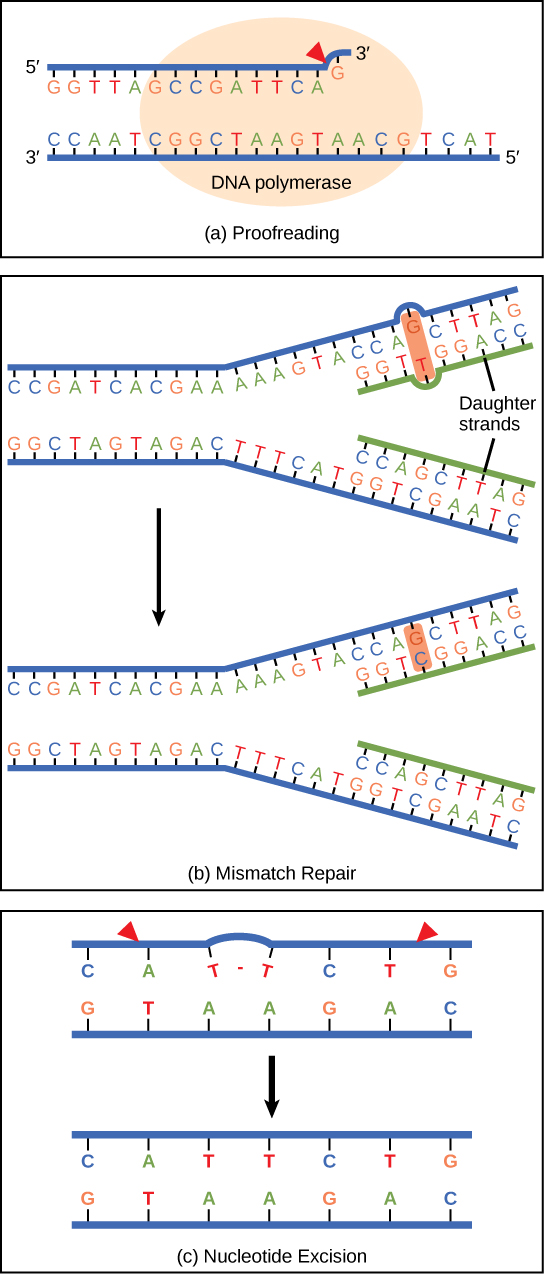
9 2 Dna Replication Concepts Of Biology 1st Canadian Edition
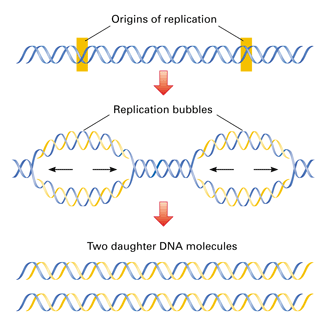
Chapter 11 Concept 11 3

Dna Replication
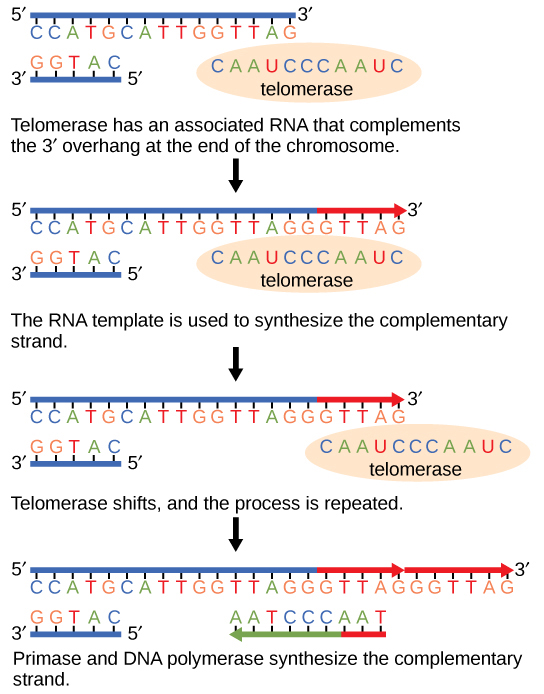
9 2 Dna Replication Concepts Of Biology 1st Canadian Edition



0 Comments